In a gold mine two miles down, one ton of rock yields a little over 11 grams of gold
 (full size, opens in a new tab)
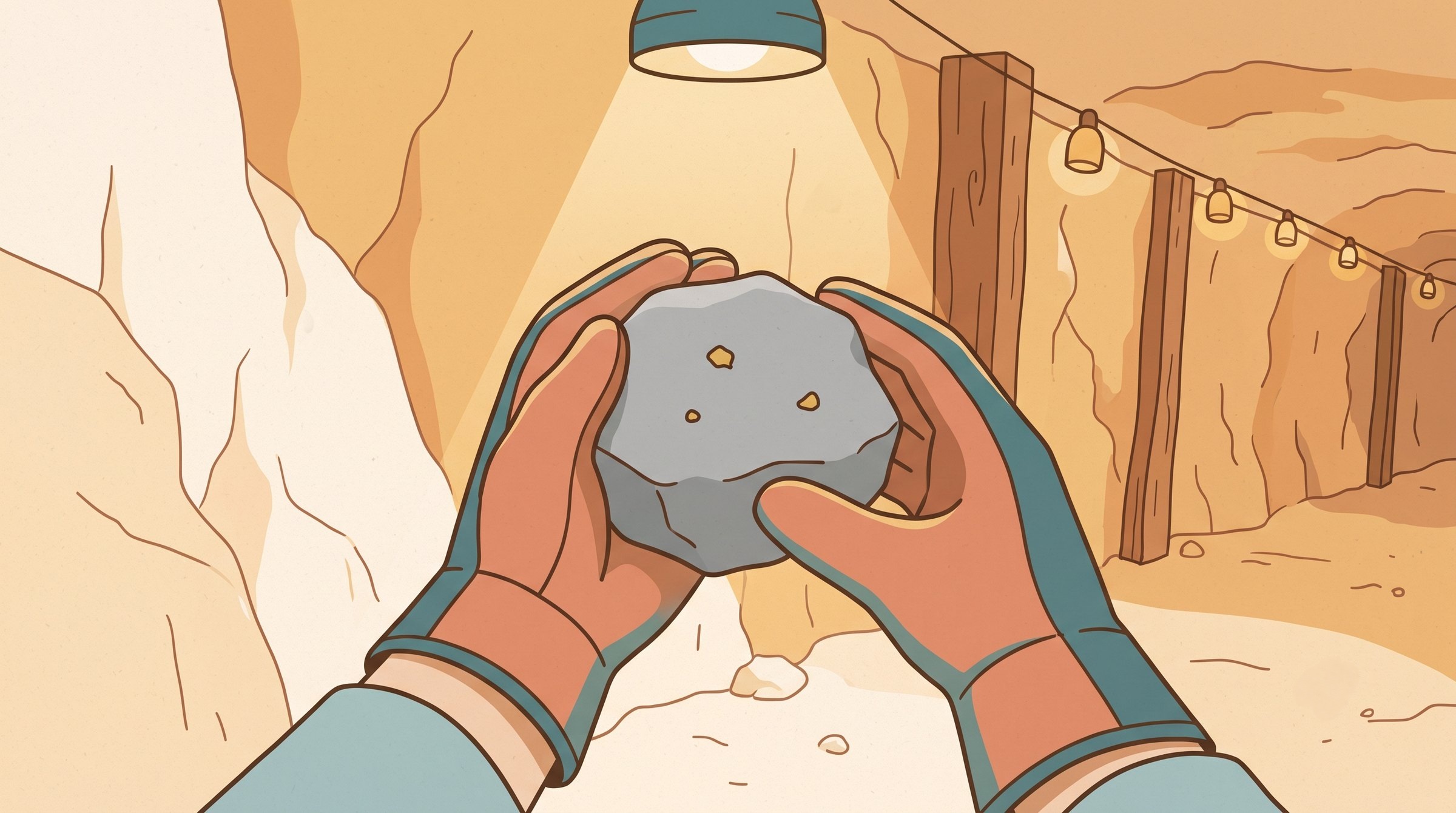
The Mponeng mine in South Africa is the deepest mine in the world, according to the company that runs it. Its miners go down more than 3 kilometers, nearly two miles, to cut rock. In the financial year ended June 2025, a metric ton of that rock yielded a little over 11 grams of gold on average. That weighs a little more than two U.S. nickels.
That is why gold is slow to increase. However much people want it, they can mine only what the earth gives up.
The amount of money we use, on the other hand, usually grows a little each year. So who decides how much of it there is? In February 2009, a few months after the 2008 financial crisis, Bitcoin’s creator, who used the name Satoshi Nakamoto, raised this question. He asked how far we can trust whoever decides to create more money.
For gold, the earth sets the amount. For the dollar, a central bank’s judgment does. Bitcoin hands that job to a rule: a schedule, published to everyone from the start, of how much new bitcoin is issued and when.
Gold increases only as fast as the earth gives it up
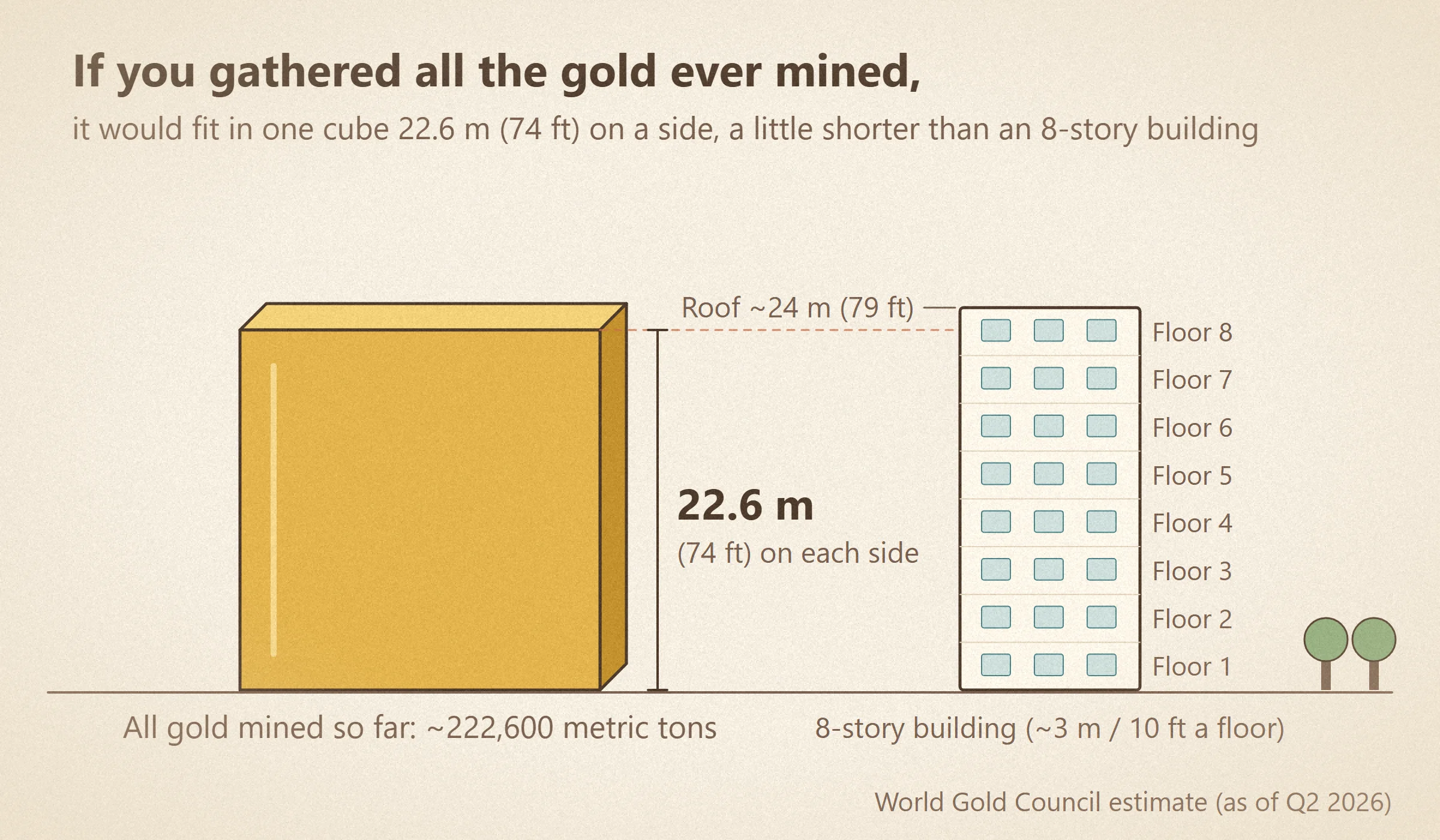
The World Gold Council estimates that people have mined about 222,600 metric tons of gold in all of history (as of the end of June 2026). Melted into a single cube, it would measure about 22.6 meters, or 74 feet, on each side. Thousands of years of mining would fit in one block a little shorter than an eight-story building.
 (full size, opens in a new tab)
In 2025, mines produced 3,672 metric tons of new gold, the most on record by the first estimate. Compared with all the gold already above ground, that adds about 1.6% in a year. It’s the share that mines have kept adding, year after year, to thousands of years of gold.
Even when the price rises, gold doesn’t increase quickly. The average gold price in 2025 was 44% higher than the year before. Yet mine output grew by less than 1%.
The World Gold Council traces this to how long mining takes. It can take decades to go from discovering a deposit to actually producing gold, so mining can’t keep pace with the price.
So people don’t decide how much gold there is. How much lies underground, and how long it takes to dig out, decide that. Since no one can suddenly make a lot more gold, the share that one gold coin represents doesn’t suddenly shrink. That slow pace is one reason people have trusted gold for so long.
Until 1971, foreign governments could turn their dollars into gold
Trust in gold carried over to money. For a long time, many countries’ money was tied to gold. Until 1971, the United States exchanged dollars presented by foreign governments for gold. The price was fixed at $35 for an ounce of gold.
Print too many dollars, and requests to exchange them would pile up, draining gold. So the promise worked like a leash that held the amount of dollars in check.
That leash had a cost. During the Great Depression of the 1930s, banks failed one after another, and the amount of money shrank. According to the Federal Reserve’s history site, it fell by nearly 30% in a little over two years.
The Federal Reserve (the Fed), America’s central bank, even raised interest rates at one point to defend the gold standard. It failed to stop the money supply from shrinking.
In 2002, Ben Bernanke, then a Fed governor, said this about that period:
“Regarding the Great Depression … we did it. We’re very sorry.”
The leash held after that, but dollars spread around the world grew a great deal, partly through U.S. military spending and foreign aid. In the end, the Fed’s history site notes, foreigners held more dollars than the United States held gold. If everyone asked for gold at once, the country couldn’t pay.
 (full size, opens in a new tab)
On August 15, 1971, President Nixon closed the door on foreign governments exchanging dollars for gold. The Fed’s history site describes that day as the moment the international monetary system shifted to fiat money. From then on, the amount of dollars was managed by a central bank’s judgment instead of by gold.
Central banks adjust the amount of money as they watch the economy
In the United States today, that judgment belongs to the Fed’s Federal Open Market Committee. The Fed’s guide, checked October 18, 2026, provides for 12 voting members and eight regular meetings a year. The Fed describes monetary policy as influencing how available and how costly money and credit are.
Here’s how it works. The Fed acts on the money that banks keep in their accounts at the Fed. That moves the rate banks charge each other for overnight loans, and the rate spreads out to loans and savings accounts.
The actual amount of money also grows and shrinks as banks make loans and collect them. The central bank guides that flow by moving its price, the interest rate. In place of a gold mine’s pace, a meeting room’s judgment steers the flow of money.
The Fed’s top goals are set in law: maximum employment and stable prices. The Fed’s explanation, checked October 18, 2026, sets out a longer-run goal of 2 percent inflation. It uses the personal consumption expenditures price index to measure that inflation.
 (full size, opens in a new tab)
The strength of this approach is that it can respond to events. As the financial crisis spread, the Fed cut its policy rate to nearly zero by the end of 2008. Starting that November, it also bought long-term Treasury bonds and mortgage-backed securities on a large scale.
The aim was to bring long-term interest rates down and support the economy. Unlike in the Depression, the Fed could expand money and credit generously when it was needed.
In this approach, trust rests on the people who make the judgment and on the process. So central banks announce their goals in advance and explain their decisions and the reasons for them. The Fed issues a statement after every meeting, and its chair holds a press conference. The same guide says minutes of regular meetings come out three weeks after the policy decision.
Satoshi raised a question about exactly this kind of trust. He saw the problem in the very need to trust a central bank not to let the currency lose its value. The first essay told that story in detail.
Bitcoin gave a different answer to the same question.
Bitcoin published how much would be issued, and when, from day one
On January 8, 2009, Satoshi released the first Bitcoin software and sent out an email. That email already laid out the whole issuance schedule.
“Total circulation will be 21,000,000 coins. It’ll be distributed to network nodes when they make blocks, with the amount cut in half every 4 years.”
The rule still holds. About every 10 minutes on average, Bitcoin’s ledger gathers the transactions since the last batch and adds them like a new page. Each batch is called a block, and making blocks and adding them to the ledger is called mining. The miner who adds a block receives a set number of new bitcoin, and this is the only way new bitcoin comes into being.
At first it was 50 per block, cut in half every 210,000 blocks. This is called the halving. The first halving came in November 2012, and the most recent in April 2024.
Today each block brings 3.125 new bitcoin, or about 450 a day on average. As of October 3, 2026, about 20.09 million bitcoin had been issued. The next halving is due around 2028, and new issuance ends around 2140.
So who makes sure the rule is kept? As the second essay showed, computers holding a copy of the ledger check every new block to see that it doesn’t create more than the set amount. A block that pays its miner more than the rule allows is turned away by every computer checking by the rules. So the amount of bitcoin doesn’t wait on anyone’s judgment, and anyone can work it out in advance.
The math is simple. Start at 50 and halve it every 210,000 blocks. That tells you, today, roughly how much will be issued in any year up to around 2140. Work it out in 2026 or in 2009, and you get the same answer.
 (full size, opens in a new tab)
A fixed issuance schedule has its costs, too
A set schedule comes with its own costs.
First, the amount can’t be increased to fit the economy. Bitcoin has no way to pour money in during a crisis the way the Fed did in 2008. Remember what money tied to gold went through in the Depression, and that is no small cost.
Second, no new bitcoin is issued to make up for lost bitcoin. Bitcoin that its owner can no longer spend stays in the ledger and never moves again (Bitcoin.org). The first essay explained how that can happen: whoever loses the secret words that unlock their bitcoin can’t get it back.
Third, the reward of new bitcoin keeps getting smaller. Miners spend heavily on computing equipment and electricity to make new blocks and protect the ledger. In return they receive new bitcoin and transaction fees, and as the new bitcoin shrinks, fees have to make up that share.
Satoshi wrote in that first email of 2009 that once issuance runs out, the system can rely on transaction fees. Bitcoin.org likewise expects miners will then probably be supported by fees alone. Whether those fees will be enough to keep the ledger well protected is a question still to be worked out.
Fourth, the rule itself is something people chose. As the second essay showed, the rules change only if users, miners, and node operators adopt the change themselves. The 21 million figure holds because many people keep choosing the same rule.
A set supply doesn’t make for a steady price, either. Bitcoin’s price rises and falls sharply, as the first essay noted.
How a money’s supply is set shows where its trust is placed
Go back down the mine, two miles underground. The slow pace of 11 grams of gold from a ton of rock let the earth, not people, set the amount of gold. That slow pace helped gold earn trust over a long time. But when money was tied to gold, it was hard to expand the amount of money generously in a crisis.
Today’s dollar takes a different path. A central bank watches the economy and adjusts the amount by judgment. Being able to move quickly in a crisis is the strength of this approach. That judgment earns trust through published goals, regular meetings, and explanations after each one.
Bitcoin answered the question 2008 raised with a rule. It left the amount to a schedule published on day one, not to anyone’s judgment. In exchange, it can’t add more in a crisis.
Bitcoin’s miners, who add new blocks to the ledger, receive new bitcoin for that work. As that reward shrinks, transaction fees will have to take its place, and that question remains open.
None of the three is simply better than the others. Each puts its trust in a different place: the earth, human judgment, or a published schedule. Behind every news story about money being added to the economy, there is a story of who decided how much, and how.
While you’ve been reading, miners at Mponeng have been breaking rock underground. On Bitcoin’s side, a new batch of transactions has been added about every 10 minutes on average. Each time, 3.125 new bitcoin are issued. Both keep growing, a little at a time, each at its own pace.
The next essay starts with twelve words written on a slip of paper. It follows who keeps your money safe.
Glossary
- Satoshi Nakamoto: The name used by the developer who designed Bitcoin and released it in 2009. Their real identity is unknown.
- World Gold Council: An organization formed by major gold-mining companies. It tracks and publishes figures on gold supply and demand.
- Gold standard (gold convertibility): A promise to exchange money for gold at a fixed price, which ties the amount of money to gold.
- Fiat money: Money that isn’t backed by a promise to exchange it for something like gold, and is used as money by law and custom. Today’s dollar is fiat money.
- Federal Reserve (the Fed), Federal Open Market Committee: The Fed is the central bank system of the United States. The Federal Open Market Committee is the group within it that sets monetary policy (12 voting members, eight regular meetings a year).
- Great Depression: The worldwide economic downturn that began around 1929 and lasted through the 1930s.
- Policy rate: The interest rate a central bank sets as a tool of monetary policy. The Fed sets a target range for the rate banks charge each other on overnight loans (the federal funds rate).
- Mortgage-backed securities: Bonds made by bundling many home loans together so they can be bought and sold.
- Block, mining: A block is one page of Bitcoin’s ledger, a batch of transaction records. Mining is making a new block and adding it to the ledger; whoever adds it receives the new bitcoin set by the rules, plus transaction fees.
- Halving: The rule that cuts the new bitcoin per block in half every 210,000 blocks (about four years).
- Transaction fee: A fee paid when sending bitcoin. It goes to the miner who puts the transaction in the ledger.
- Node: A computer that downloads a full copy of the ledger and checks for itself that each new block follows the rules.
- Bitcoin, bitcoin: In this essay, Bitcoin (capital B) is the system and its ledger; bitcoin (small b) is the money and its units.
Sources (17)
- Harmony Gold, “Mponeng” (3,160 to 3,740 meters below the surface; the deepest mine in the world; average recovered grade of 11.27 grams per ton in fiscal year 2025): https://www.harmony.co.za/operations/south-africa/mponeng/
- World Gold Council, “How much gold has been mined?” (about 222,600 metric tons as of the end of Q2 2026; a cube about 22.6 meters on each side): https://www.gold.org/goldhub/data/how-much-gold
- World Gold Council, Gold Demand Trends Full Year 2025, Supply (2025 mine production of 3,672 metric tons, a record by the first estimate and subject to revision (9 metric tons above 2018’s 3,663); growth of less than 1% year on year; annual average gold price up 44%): https://www.gold.org/goldhub/research/gold-demand-trends/gold-demand-trends-full-year-2025/supply
- World Gold Council, “Gold mining” (mine production is slow to respond to price; going from discovery to production can take decades): https://www.gold.org/gold-supply/gold-mining
- Federal Reserve History, “Nixon Ends Convertibility of U.S. Dollars to Gold” (August 15, 1971; $35 an ounce; gold window closed to foreign governments; shift to a fiat money system): https://www.federalreservehistory.org/essays/gold-convertibility-ends
- Federal Reserve History, “The Great Depression” (money supply fell by nearly 30% from fall 1930 to winter 1933; interest rates raised in fall 1931 to defend the gold standard; “failure to stem the decline in the supply of money”; Bernanke’s 2002 remarks): https://www.federalreservehistory.org/essays/great-depression
- Federal Reserve History, “The Great Recession and Its Aftermath” (policy rate target of 0 to 0.25% by the end of 2008; large-scale purchases of mortgage-backed securities and longer-term Treasury securities from November 2008, and their purpose): https://www.federalreservehistory.org/essays/great-recession-and-its-aftermath
- Board of Governors of the Federal Reserve System, “Meeting calendars, statements, and minutes” (statements and press conferences after meetings; minutes released three weeks after each decision): https://www.federalreserve.gov/monetarypolicy/fomccalendars.htm
- Board of Governors of the Federal Reserve System, “Federal Open Market Committee” (12 voting members; eight regular meetings a year; definition of monetary policy): https://www.federalreserve.gov/monetarypolicy/fomc.htm
- Board of Governors of the Federal Reserve System, “Why does the Federal Reserve aim for inflation of 2 percent over the longer run?” (2 percent inflation, measured by the price index for personal consumption expenditures, judged most consistent with the mandate for maximum employment and price stability): https://www.federalreserve.gov/faqs/economy_14400.htm
- Satoshi Nakamoto, “Bitcoin v0.1 released” (January 8, 2009; total circulation of 21 million; halved every four years; when issuance runs out, the system can support transaction fees), Satoshi Nakamoto Institute archive: https://satoshi.nakamotoinstitute.org/emails/cryptography/16/
- Bitcoin Core source code,
GetBlockSubsidy(block reward starts at 50 and halves) and rejection of blocks that pay too much (bad-cb-amount), src/validation.cpp: https://github.com/bitcoin/bitcoin/blob/master/src/validation.cpp ; halving intervalnSubsidyHalvingInterval = 210000, src/kernel/chainparams.cpp: https://github.com/bitcoin/bitcoin/blob/master/src/kernel/chainparams.cpp - mempool.space (block 210,000 mined November 28, 2012; block 840,000 mined April 20, 2024; block height 969,609 on October 3, 2026): https://mempool.space/
- Bitcoin.org FAQ (issuance shrinks and stops at 21 million; after that, miners will probably be supported by transaction fees; lost bitcoin stays in the ledger but will “remain dormant forever”; rule changes take effect only if users, miners, and node operators voluntarily adopt them): https://bitcoin.org/en/faq
-
The first essay, “Bitcoin Is a Public Record of Money. Here’s How It Works” (the 2008 financial crisis, Satoshi’s February 11, 2009 post, lost keys, price swings), and the second essay, “Gold on the Scale, Bitcoin in the Ledger” (how nodes check blocks, how rules change), collect their own sources: https://eastynotes.com/en/bitcoin-public-record-of-money/ , https://eastynotes.com/en/gold-on-the-scale-bitcoin-in-the-ledger/
-
The diagram showing all the gold mined as a single cube was made by the author. Gold figures are World Gold Council estimates (as of Q2 2026); one floor is taken as about 3 meters (10 feet).
- Four illustrations: generated with Google Gemini, an AI image tool (October 5, 2026). They are reconstructions of scenes, not photographs. The figure in the 1971 scene is not modeled on the real person’s appearance, and the meeting does not depict any specific institution’s meeting.
Written October 5, 2026. Adapted from the Korean edition (October 5, 2026).